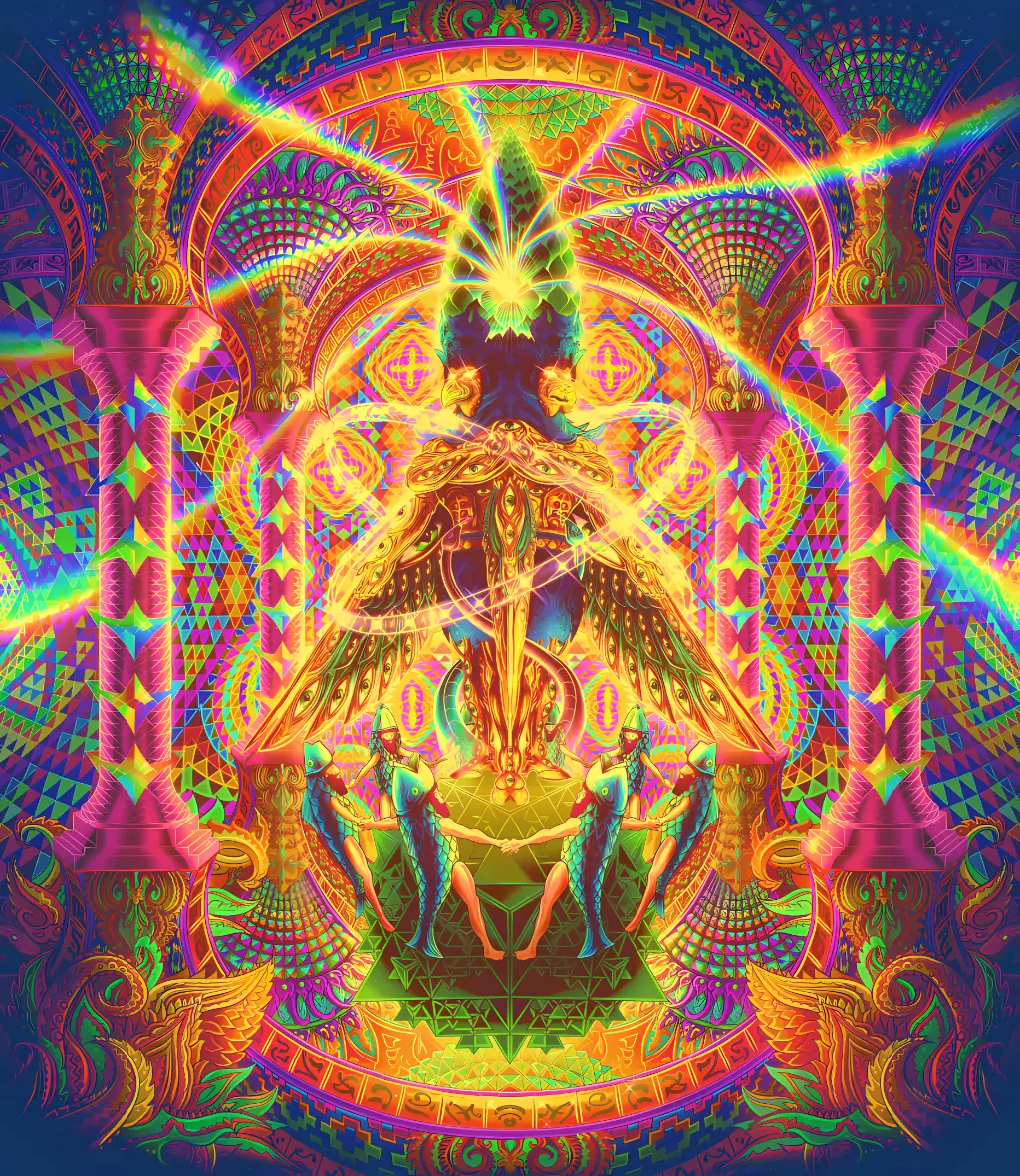
Internal hallucination
An internal hallucination is the perception of a visual hallucination that exclusively occurs within an imagined environment that can typically only be viewed with closed eyes, similar to those found within dreams. They are most commonly induced under the influence of heavy dosages of hallucinogenic compounds, such as psychedelics, dissociatives, and deliriants.
An internal hallucination is the perception of a visual hallucination that exclusively occurs within an imagined environment that can typically only be viewed with closed eyes,12 similar to those found within dreams.345 This is in stark contrast to external hallucinations, which display themselves seamlessly into the person's surrounding environment as if they were physically present.
At lower levels, internal hallucinations begin with imagery on the back of a person's eyelids, which do not take up the entirety of one's visual field and are distinct from their background. These can be described as spontaneous moving or still images of scenes, concepts, places, or anything one could imagine. The imagery is manifested in varying levels of realism ranging from ill-defined and cartoon-like to wholly realistic. They rarely hold their form for more than a few seconds before fading or shifting into another image. It is worth noting that this level of intensity occurs in a manner similar to that of hypnagogia, the state between sleep and wakefulness.
At higher levels, internal hallucinations become increasingly elaborate as they eventually become all-encompassing, fully-fledged 3D scenes that surround the person in a manner similar to that of dreams. This can create the feeling that one has "broken-through" into another reality. The things that occur within this perceived alternate reality can be anything, but fall under common archetypes such as contact with autonomous entities, alongside a wide variety of imagined landscapes and scenarios.
This effect is capable of manifesting itself across the 5 different levels of intensity described below:
- Autonomous entities
- Perspective hallucinations
- Scenarios and plots
- Settings, Sceneries, and Landscapes
Style Variations
The specific differences between each potential style of internal hallucination can be broken down into the following variations:
Replications
Personal Commentary
Internal hallucinations are easily one of the most highly sought after effects within the hallucinogenic experience. At their higher levels, they can offer a near infinite wealth of experiences and show people things so unfathomable that it will often cause them to question how these hallucinations could possibly even originate from their own mind. It has always fascinated me that the brain is quite capable of instantaneously rendering scenes and images that are so detailed, intricate, and vivid that they are often incomprehensible beyond anything that could ever occur within the real world.
However, after a lot of contemplation and experiences with both hallucinatory states and lucid dreaming, I now strongly suspect that internal hallucinations are quite likely to be the drug induced equivalent of the various scenes that most people commonly encounter within their dreams. This is because there are a number of interesting commonalities between dreams and hallucinations that are too substantial for me to ignore. For example, I think it is interesting that when leaving something such as a sudden onset hallucination, there is often a feeling of amnesia that's identical to the feeling of waking up from a dream. Alongside of this, there is often an identical sense of plot acceptance within both dreams and hallucinations that results in the person immediately accepting their current situation as a real life event.
From personal experience, I can also confirm that the well established "reality checks" that can be used within Lucid Dreams to determine whether or not one is currently awake or asleep, do in fact work just as well within high-level drug induced hallucinations. For example, within a dream, subtle details such as written text and clock faces are seemingly incapable of rendering in a static manner. So if a person looks at one of these things, takes note of them, looks away, and then looks back, they will find without fail that the content suddenly changes its appearance each and every single time. This is also true for internal hallucinations in exactly the same manner.
On a less important note, I think it's interesting to consider that the leveling system listed above can not only be applied to internal hallucinations, but can also be applied to the experience of hypnagogia and fully fledged dreams without any significant modifications to its wording. Alongside of this, the levelling system that I devised to measure the coherency of an autonomous entities communication methods can also be perfectly applied to that of dream characters without any modification at all. This was completely unintentional for both of these leveling systems and is, in my personal opinion, not a coincidence.
Although it could be argued that internal hallucinations are too characteristically different from that of dreams to possibly stem from the similar neurological processes, I think that these differences in their presentation are largely the result of the many other effects that are often simultaneously occurring during these experiences. The most notable one is geometry, which can cause the hallucination to be comprised of the otherworldly shapes and patterns that provide psychedelic hallucinations in particular with their distinctly "hyperspatial" aesthetic. Alongside of this, various other subjective effects such as synaesthesia, machinescapes, recursion, time distortion, and transpersonal states can all potentially further synergize with the experience.
However, I am fully aware that this position is merely one of pure speculation and that I cannot prove this definitively. As the years go by, I am therefore hoping that further scientific research and study into this topic will be able to help elucidate the precise neurological causes behind this fascinating experience.
 Josie Kins~2017–2021