
Deliriant

Subjective Effects of Deliriants

Deliriants are a class of hallucinogen that are unique in that they offer solid hallucinations which display themselves seamlessly into waking consciousness, similar to fully formed dreams. These hallucinations are also characterised by delusions and psychosis as they are most often immediately accepted as reality by the person experiencing them. In contrast, classical psychedelics and dissociatives have progressive levels of multiple all-encompassing sensory effects before reaching the level of concrete hallucination. They also rarely induce psychosis, with most people maintaining an understanding that they are simply under the influence of a substance throughout any hallucinations which they undergo.

Outside of these delirious external hallucinations, deliriant trips are primarily characterised by incredibly uncomfortable and often dangerous physical side effects alongside deep feelings of fear, anxiety, and confusion. It is because of this that deliriant substances hold no therapeutic or recreational potential and are instead merely curiosities that should not be experimented with by any but the most experienced of psychonauts.

This page breaks down the subjective effects of the deliriant experience into simple and easy to understand descriptions. These descriptions are not specific to any particular substance but are applicable to effects which commonly occur under the influence of almost any deliriant compound.

Diphenhydramine (DPH), Datura, Atropine, Hyoscyamine, Scopolamine, Dimenhydrinate, Doxylamine, Benzydamine, Elemicin, Brugmansia, Atropa Belladonna, Hyoscyamus Niger, Mandragora Officinarum

The article begins with simpler effects and works up toward more complex experiences. Each effect links to its full article.

Visual Effects

Visual effects are any subjective experience which directly alters a person's sense of sight.

Peripheral information misinterpretation

Peripheral information misinterpretation is a fleeting experience of an object or detail within one's peripheral vision being interpreted and displayed incorrectly. During this state, a person may briefly see elaborate details within their peripheral vision that, after a more direct analysis, turn out to be entirely fabricated. For example, a person may momentarily notice fleeting objects, people, or events within their peripheral vision that are not actually present. Once the detail or object is realized to be incorrect, the misinterpretation is overwritten with the correct perception.

Peripheral information misinterpretation is often accompanied and enhanced by other coinciding effects, such as pattern recognition enhancement and external hallucinations. It is most commonly induced under the influence of moderate dosages of deliriant compounds, such as DPH, datura, and benzydamine. However, it can also occur under the influence of stimulant psychosis and sleep deprivation.

Brightness alteration

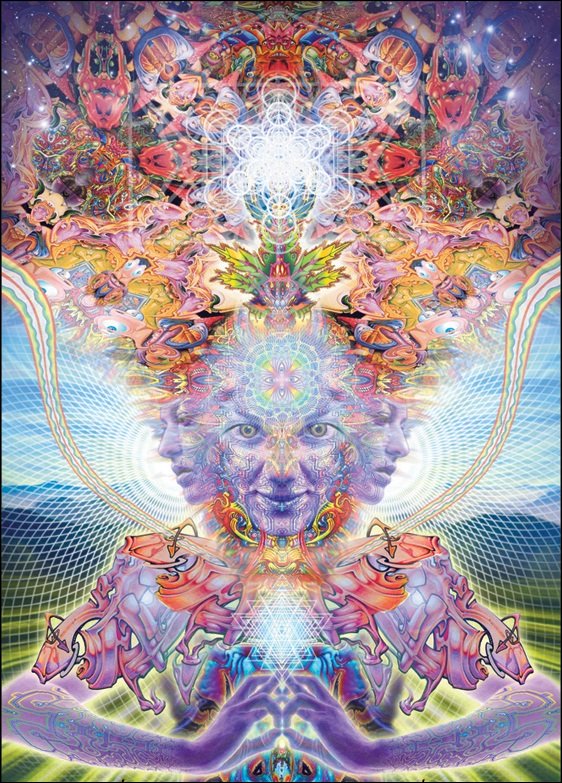
Brightness alteration is a distortion or change in the intensity of perceived brightness comprising a person's vision. This usually results in the person's vision becoming dimmer or darker, but could also potentially result in it becoming lighter and more vivid depending on the person's environment and substances they have consumed.

Brightness alteration can be accompanied by the coinciding effects of pupil dilation or constriction and photophobia. It is most commonly induced under the influence of moderate dosages of hallucinogenic compounds, such as psychedelics, dissociatives, and deliriants.

External hallucination

Deliriants
by Anonymous 420chan User

An external hallucination is the perception of a visual hallucination that displays itself seamlessly into the external environment as if it were physically present. This is in stark contrast to internal hallucinations, such as dreams, that occur exclusively within an imagined environment and can typically only be viewed with closed eyes.

At lower levels, external hallucinations are visible within one's direct line of sight, but are not fully defined in their appearance. This means that, although visible, they do not look completely detailed and are often extremely blurry or semi-translucent with little to no colour. However, at higher levels, the hallucinations become completely realistic and will rarely disappear due to a double take. At this point, they are now capable of a completely convincing and photorealistic appearance and their behaviour becomes far more lifelike. Additionally, they may become numerous enough to fully engulf the entirety of the person's environment.

The content within these external hallucinations can be further broken down into four distinct subcomponents. These commonly include autonomous entities, object activation, scenarios and plots, and settings, and shadow people.

It is worth noting that the content, style, and general behaviour of an external hallucination is often largely dependent on the emotional state of the person experiencing it. For example, a person who is emotionally stable and generally happy will usually be more prone to experiencing neutral, interesting, or positive hallucinations. In contrast, a person who is emotionally unstable and generally unhappy will usually be more prone to experiencing sinister, fear-inducing, and negative hallucinations.

External hallucinations are often accompanied by other coinciding effects, such as delirium, internal hallucinations, and delusions. They are most commonly induced under the influence of heavy dosages of deliriant compounds, such as DPH, datura, and benzydamine.

Object alteration

An object alteration is the experience of perceiving objects and scenes to be progressively warping, moving, stretching, animating, and shifting in their 3-dimensional form. When the person double takes, the object returns to its original shape until it is looked at directly once again, whereafter it begins distorting again in a similar or different manner. The manner in which the alterations occur is not uniform and cannot be reliably predicted. The intensity of the effect is often linked to the intensity and progression of the mental state that precludes this effect.

For example, when staring at an object, such as a chair, its 3-dimensional shape may begin to drastically elongate or tilt into an exaggerated form while retaining its original colours and textures.

Another common manifestation of this effect is the perception of textures progressively extending and stretching outward from surfaces of objects in the form of a detailed 3-dimensional structure somewhat similar to complex, opaque, and solidified smoke. These structures usually maintain a size consistent with the width of the texture it is extending from. They can also range from anywhere between several inches to several meters in length. For example, if one is staring at a painting on the wall, it may extend in one direction on a 2-dimensional plane until the observer looks away.

Object alterations are often accompanied by other coinciding effects, such as delirium and psychosis. They are most commonly induced under the influence of heavy dosages of deliriant compounds, such as DPH and datura. However, they can also occur under the influence of stimulant psychosis and sleep deprivation.
Visual haze

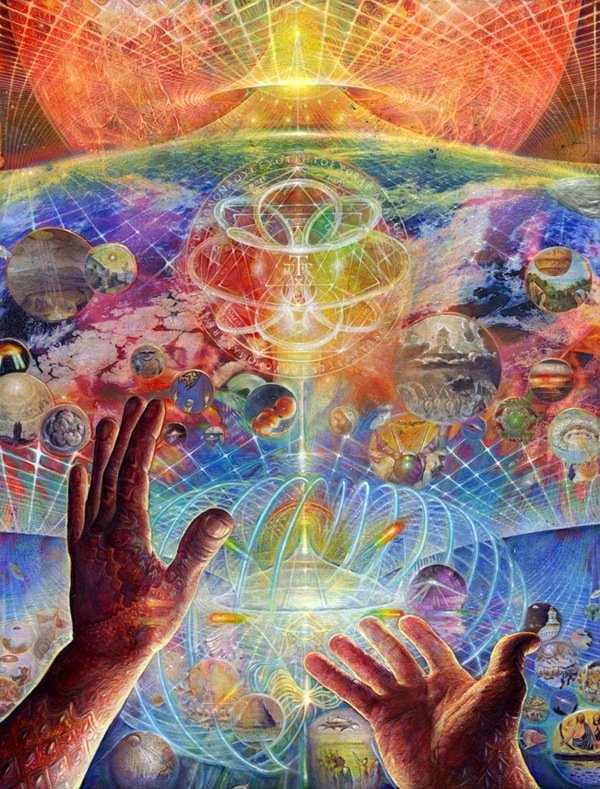
Visual haze distorts the surrounding environment to make it appear as if the air is shrouded in an imaginary cloud of smoke, fog, or haze. This effect varies in its intensity, ranging from subtle and barely visible to extreme and all-encompassing in a manner that can significantly impair a person's vision.

Visual haze is often accompanied by other coinciding effects, such as acuity suppression and external hallucinations. It is most commonly induced under the influence of mild dosages of hallucinogenic compounds, such as psychedelics, deliriants, and cannabinoids. However, it can also occur less commonly under the influence of stimulant psychosis and sleep deprivation.

Autonomous entity

Effect replication
by Luke Brown

An autonomous entity is the experience of perceived contact with beings that appear to be sentient and autonomous in their behaviour. They will frequently act as the inhabitants of a perceived independent reality. Although many entities seem largely unaware of a person’s presence, they are often precognizant of a person's appearance into their realm and usually choose to interact with them in various ways. The behaviour of a typical entity can vary wildly and seems to depend heavily on one's current emotional state. For example, while many entities will act as loving beings, teachers, or healers in certain contexts, they are equally capable of acting as indifferent, uncaring or even malicious tormentors.

Entities under the influence of psychedelics usually appear as if they are comprised of condensed psychedelic geometry. They can take any form, but certain archetypes are present and commonly include:

Humans, shadow people, bodiless super intelligent humanoids, aliens, elves, animals, giant spheres, insectoids, beings of light, anthropomorphic beings, plants, conscious inanimate objects, fictional characters, cartoons, robotic machines, gods, demigods, goddesses, bio-mechanical intelligences, hooded figures, demons, indescribable monstrosities, spirits, angels, shamans, ghosts, souls, ancestors, fantastical or mythological beasts, glitch creatures and more.

This experience is often accompanied by other coinciding effects, such as geometry, internal hallucinations, and delusions. It is most commonly induced under the influence of heavy dosages of hallucinogenic compounds, such as psychedelics, dissociatives, and deliriants.

Object activation

Object activation is the experience of looking at an object and perceiving it to move, become alive, or become fully animated and autonomous of its own accord. For example, a door may open and close on its own or a cup on the table may start to slide or tilt over. The "activated object" usually moves in a familiar way that would happen in day to day life, implying that the person is experiencing a combination of both object alterations and external hallucinations being applied to their environment.

However, certain activated objects may also perform actions that are completely unrealistic. For example, an item of furniture may appear to disassemble into many complex, floating, and rotating sections before reassembling into its previous form. Stationary objects, such as rugs, may activate themselves and begin crawling on the floor and up onto other stationary pieces of furniture. These hallucinations usually only occur when one looks directly at an object for an extended period of time and are rare and extreme signs of an advanced hallucinatory state.

Object activation is often accompanied by other coinciding effects, such as delirium, psychosis, cognitive dysphoria, and delusions in a manner that can result in the hallucinations being perceived to have distinctly sinister and unsettling undertones. It is most commonly induced under the influence of heavy dosages of deliriant compounds, such as DPH, datura, and benzydamine. However, they can also occur to a lesser extent under the influence of psychedelics, dissociatives, stimulant psychosis, and sleep deprivation.

Shadow people

Shadow group
by Anonymous

Shadow people describes the experience of perceiving patches of shadow in one's peripheral or direct line of sight to appear and behave as living, autonomous beings. Due to the unique behaviour of these hallucinations, they can be considered as a distinct subtype of autonomous entities.

Shadow people usually appear initially as fleeting images in a person's peripheral vision. However, at higher levels of intensity, shadow people may appear in full view. This allows the user to directly look at one in their central line of sight. At higher levels of intensity, it becomes possible to look away from and back to a shadow person without a change in the presence or appearance of the hallucination.

The bodies of shadow people are usually perceived as being comprised of blackness that has a sense of depth and few facial or body features. The blackness of their bodies often seem almost opaque, as if one is looking into a "black hole" in humanoid form. They may also appear in the shape of animals, uniform blobs, disembodied body parts, or a myriad of other indescribable shapes. They sometimes appear to have faces, eyes, or mouths and are able to move or change shape. The movement exhibited can be normal human movement or it can be faster, slower, or choppier than a normal person's gait. It is also possible for multiple shadow people to occupy one's field of vision simultaneously while acting autonomously from one another, sometimes even interacting with each other.

Shadow people are often accompanied by other coinciding effects, such as delirium, paranoia, anxiety, and feelings of impending doom. They are most commonly induced under the influence of heavy dosages of deliriant compounds, such as DPH, datura, and benzydamine. However, they can also occur under the influence of stimulant psychosis, sleep deprivation, and during sleep paralysis.

Unspeakable horrors

National Park
by H. R. Giger
Unspeakable horrors describe the experience of prolonged exposure to indescribable scenarios and hallucinatory content of a scary and disturbing nature, which are often directly influenced by a person's fears. This can occur during high dose hallucinogenic experiences, particularly those in which the user is currently undergoing negative emotional stressors and personal problems of an introspective nature. Although the content that comprises these states are generally ineffable and largely dependent on the fears of those who experience them, certain themes and archetypes often manifest themselves. These may consist of, but are not limited to:
  • Autonomous entities of an intrinsically sinister and threatening nature - This can include demons, deformed monstrosities, hooded figures, mocking entities and otherwise normal human beings deformed by severe injury or illness.
  • Scenarios and plots of an intrinsically sinister and threatening nature- This can include scenes of suffering directed towards oneself or other people, such as being tortured, scenes in which one is being hunted as prey by "evil" creatures or forces, and the direct experience of one's personal fears.
  • Settings, sceneries, and landscapes of an intrinsically sinister and threatening nature - This can include the visitation of hellish landscapes, ancient monolithic Lovecraftian architecture, and ruined civilizations.
  • Fearing for the fabric of one's sanity** - This can be described as feeling as if one's current perception is so horrific that they will surely be left permanently insane with severe psychological damage. The effect can leave people with an immediate sense that ordinary life is a thin shell over a comparatively horrifying reality, one which cannot be dismissed or escaped from. Despite these hallucinations being extremely stressful, this effect rarely leaves individuals with lasting psychological problems.
Unspeakable horrors are often accompanied by other coinciding effects, such as anxiety, psychosis, and memory suppression. They are most commonly induced under the influence of heavy dosages of psychedelic compounds, such as LSD, psilocybin, and 2C-P. They can also occur under the influence of deliriants, such as DPH, datura, and benzydamine.

Internal hallucination

Effect replication
by Adam Scott Miller
An internal hallucination is the perception of a visual hallucination that exclusively occurs within an imagined environment and can typically only be viewed with closed eyes, similar to those found within dreams. This is in stark contrast to external hallucinations, which display themselves seamlessly into the external environment as if they were physically present. At lower levels, internal hallucinations begin with imagery on the back of a person's eyelids, which do not take up the entirety of one's visual field and are distinct from their background. These can be described as spontaneous moving or still images of scenes, concepts, places, or anything one could imagine. The imagery is manifested in varying levels of realism ranging from ill-defined and cartoon-like to wholly realistic. They rarely hold their form for more than a few seconds before fading or shifting into another image. It is worth noting that this level of intensity occurs in a manner similar to that of hypnagogia, the state between sleep and wakefulness. At higher levels, internal hallucinations become increasingly elaborate as they eventually become all-encompassing, fully-fledged 3D scenes that surround the person in a manner similar to that of dreams. This can create the feeling that one has "broken-through" into another reality. The things that occur within this perceived alternate reality can be anything, but fall under common archetypes such as contact with autonomous entities, alongside a wide variety of imagined landscapes, and scenarios. Internal hallucinations are often accompanied by other coinciding effects such as geometry, external hallucinations, and delusions. They are most commonly induced under the influence of heavy dosages of hallucinogenic compounds, such as psychedelics, dissociatives, and deliriants.

Settings, sceneries, and landscapes

Settings, sceneries, and landscapes are the perceived environment in which the plot of an internal or external hallucination occurs. This effect is capable of manifesting in a seemingly infinite variety of places and settings. When explored, the geography of these settings is capable of organizing itself as static and coherent. However, it will usually manifest as a non-linear, nonsensical, and continuously changing layout which does not obey the laws of physics. Regarding the chosen locations, appearance, and style of these settings, they seem to be selected at random and are often entirely new and previously unseen locations. They do, however, put heavy emphasis on replicating and combining real-life locations stored within the person's memories, especially those which are prominent in one's life and daily routine. There are some common themes and archetypes within this component which generally include: Jungles, rainforests, deserts, ice-scapes, cities, natural environments, caves, space habitats, vast structures, civilizations, technological utopias, ancient ruins, machinescapes, historical settings, rooms and other indoor environments, real-life locations, incomprehensible geometric landscapes, and more. Settings, sceneries, and landscapes are often accompanied by other coinciding effects, such as autonomous entities and delusions. They are most commonly induced under the influence of heavy dosages of hallucinogenic compounds, such as psychedelics, dissociatives, and deliriants.

Auditory Effects

Auditory effects are any subjective effect which directly alters a person's sense of hearing.

Auditory distortion

An auditory distortion is the experience of perceived alterations in how audible noises present and structure themselves.

These distortions can manifest in many styles, but commonly take the form of echoes or murmurs that arise from sounds and are accompanied by fluctuating changes in speed and pitch. This can intensify to the point where sounds are consistently followed by continuous reverberation, often rendering the original sound completely unrecognizable. However, it often quickly resets to base level and starts over if the source of noise is stopped or changed.

At lower levels, auditory distortions consist of subtle and spontaneous reverberations, echoes, and changes in the pitch of noises within the external environment. They are fleeting, low in intensity, and easy to ignore. However, at higher levels, auditory distortions become consistent and intense enough that they are impossible to ignore. The complexity of these resulting alterations can quickly render the original sound as unintelligible.

Auditory distortions are often accompanied by other coinciding effects, such as auditory hallucinations, auditory suppression, and auditory enhancement. They are most commonly induced under the influence of moderate dosages of psychedelic compounds, such as LSD, 5-MeO-DiPT, and DMT. However, they can also occur less commonly under the influence of dissociatives, such as ketamine, PCP, and nitrous.

🎵 Audio replication: Distorted math lecture by /u/Hyperactive_Filly

Auditory suppression

Auditory suppression is the experience of sound becoming perceived as more distant, quiet, and muffled than they actually are. This effect can significantly decrease both the volume of a noise, as well as its perceived quality. It is usually described as making it difficult to comprehend or fully pay attention to music and other sounds.

Auditory suppression is often accompanied by other coinciding effects, such as auditory distortions and auditory hallucinations. It is most commonly induced under the influence of moderate dosages of dissociative compounds, such as ketamine, PCP, and DXM. However, it can also occur less commonly under the influence of GABAergic depressants and antipsychotics such as alcohol and quetiapine.

🎵 Audio replication: Normal vs Suppressed Alan Watts by Emex

Auditory hallucination

An auditory hallucination is the experience of hearing spontaneous and imaginary noises. The most common examples of this include hearing clips of sound such as imagined music, voices, tones, popping, and scraping, but can also be an infinite variety of other potential noises that are stored within one's memory.

In terms of their behavior, these sounds will often be based on noises that were expected to occur or have been genuinely heard on a frequent basis within the external environment. For example, a person may repeatedly hear a knock at the door when they are expecting a visitor or hear music they were listening to earlier on in the day. However, at other times, auditory hallucinations may also present themselves as completely new or unusual sounds unlike anything that could currently occur within the external environment.

Auditory hallucinations are often accompanied by other coinciding effects, such as auditory distortion and auditory enhancement. They are most commonly induced under the influence of moderate dosages of hallucinogenic compounds, such as psychedelics, deliriants, and dissociatives.

🎵 Audio replication: Audio content

Tactile Effects

Tactile effects are any subjective effect which directly alters a person's sense of touch.

Tactile hallucination

A tactile hallucination is the experience of perceiving a convincing physical sensation that is not actually occurring. Common examples of this can include people or insects touching the body in various places and in a wide variety of ways. Alternatively, these hallucinations can be felt as complex and structured arrangements of vibration across the skin.

This effect may be also accompanied by visual hallucinations of a plausible cause related to the sensation. For example, during internal and external hallucinations, one may be able to touch and feel imagined objects or autonmous entities just as convincingly as within normal everyday dreams. The sensations that are possible within these hallucinations are near limitless and can even include pain or sexual pleasure.

Tactile hallucinations are most commonly induced under the influence of heavy dosages of deliriants compounds, such as DPH, datura, and benzydamine. However, they can also occur to a lesser extent under the influence of psychedelics, stimulant psychosis, and extreme sleep deprivation.

Multisensory Effects

Multisensory effects are any subjective effect which directly alters two or more senses simultaneously. Although some hallucinatory effects may affect multiple senses at one time they are usually not categorized as 'multisensory effects' unless they do so consistently.

Memory replays

Memory replays are a multisensory subtype of internal hallucinations that result in a person reliving memories through the experience of vivid daydreams, reoccurring emotions or sensations, and hallucinations. At higher levels of intensity, these are often referred to as "flashbacks". The memories themselves can be significant life events with high levels of personal meaning attributed to them, generic recent occurrences, or long forgotten experiences from childhood.

Memory replays are often accompanied by other coinciding effects, such as scenarios and plots, internal hallucinations, and introspection. They are most commonly induced under the influence of heavy dosages of hallucinogenic compounds, such as psychedelics, dissociatives, and deliriants. However, they can also commonly occur during sobriety as a result of traumatic experiences, particularly when the person suffers from post-traumatic stress disorder.

Further Effects

The remaining effect categories are summarized below. Open any effect for its full article, replications, and analysis.

Cognitive Effects

11

Cognitive effects are any subjective experience which directly alter or introduce new content to an element of a person's cognition.

Physical Effects

2

Physical effects are any subjective experience which directly affects an aspect of a person's physical body.

Uncomfortable Physical Effects

9

An uncomfortable physical effect is any substance-induced alteration of a person's physical state which is unpleasant, undesirable, painful, or otherwise a source of distress. In most cases they indicate a temporary part of a substance's interaction with the body. However, in certain contexts, they can also indicate the need for attention or even medical treatment if they become dangerously severe.

Deliriant Substances

Antihistamines

3

Other deliriants

1

Alkaloid (tropane)

2