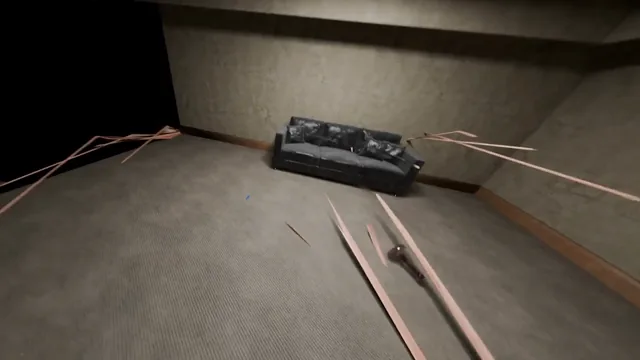
Perspective distortion
A perspective distortion is a subtle to extreme change in how a person perceives the size and distance attributed to their body, specific parts of the external environment, or the external environment as a whole. They are most commonly induced under the influence of moderate dosages of dissociative compounds, such as ketamine, PCP, MXE, and DXM.
A perspective distortion is a subtle to extreme change in how a person perceives the size and distance attributed their body, specific parts of the external environment, or the external environment as a whole.1
This effect is capable of manifesting itself in 4 different ways, which may reflect the failure of each respective responsible visual function.23456
- Macropsia - Objects are perceived larger than their actual size.
- Micropsia - Objects are perceived smaller than their actual size.
- Pelopsia - Objects are perceived to be nearer than they actually are.
- Teleopsia - Objects are perceived to be much further away than they actually are.
When affecting distance, perspective distortions can make things seem as if they are physically closer or further away than they usually would be. This can range from a subtle experience, such as the other side of the room feeling marginally further away than it usually would be, to an extreme experience, such as feeling as if the horizon is right in front of you.
In relation to size, perspective distortions can make things seem as if they are physically smaller or larger than normal.789 This can range from a subtle experience, with the room feeling marginally smaller and more cramped than it usually would be, to an extreme experience, such as feeling as if the room is hundreds of miles wide.
Perspective distortions are often accompanied by other coinciding effects, such as depth perception distortions and visual disconnection. They are most commonly induced under the influence of moderate dosages of dissociative compounds, such as ketamine, PCP, MXE, and DXM.
Alice in Wonderland Syndrome
Feelings of suddenly having an impossibly giant or tiny body are also a very common manifestation of this effect. This feeling is already known by scientific literature as “Alice in Wonderland Syndrome”, where it is seen as a temporary condition often associated with migraines, brain tumours, and the use of psychoactive drugs.110 The effect can either be attributed to the body as a whole or specific parts of it. For example, feelings of having a huge head or tiny limbs are possible.
Replications
Loading replications
Visual media is being prepared.
References
See Also
External Links

Citations
- Lev-Ran, S. (2015). LSD-associated" Alice in Wonderland Syndrome"(AIWS): A Hallucinogen Persisting Perception Disorder (HPPD) Case Report. The Israel journal of psychiatry and related sciences, 52(1), 67-68.
- Schneck JM. Macropsia. Am J Psychiatry 1965; 121:1123-1124.
- Macropsia (medical dictionary)
- Micropsia (medical dictionary)
- Pelopsia (medical dictionary)
- Telopsia (medical dictionary)
- Abraham, H. D. (1983). Visual phenomenology of the LSD flashback. Arch Gen Psychiatry, 40(8), 884-889.
- Horowitz MJ: Flashbacks: Recurrent intrusive images after the use of LSD. Am J Psychiatry 1969;126:565-569.
- Hamilton M (ed): Fish's Clinical Psychopathology. Baltimore, Williams & Wilkins Co, 1974.
- Blom, J. D. (2016). Alice in Wonderland syndrome A systematic review. Neurology: Clinical Practice, 6(3), 259-270.