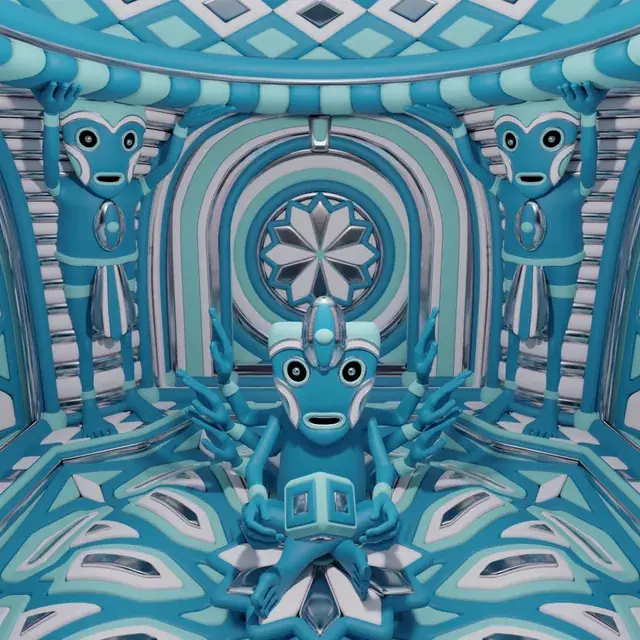
Autonomous entity
An autonomous entity is the experience of perceived contact with beings that appear to be sentient in their behaviour. They are most commonly induced under the influence of heavy dosages of hallucinogenic compounds.
An autonomous entity is the experience of perceived contact with hallucinated beings that appear to be sentient and autonomous in their behaviour.123456789 These entities can manifest within both external and internal hallucinations.8
Autonomous entities will frequently act as the inhabitants of a perceived independent reality.7 They most commonly appear alone but can also often be within small or large groups alongside of other entities. While some entities do not seem to be aware of a person's presence, others are often precognizant of a person's appearance into their realm and usually choose to interact with them in various ways. For example, they will often display behaviours such as showing a person around the realm that they inhabit, presenting them with objects, holding spontaneous celebrations of their arrival, engaging them in conversation, merging into and out of the person's body or consciousness, and attempting to impart knowledge of various kinds.
Entities can take any form, but certain archetypes are present and commonly include:
Humans,49 shadow people, bodiless super intelligent humanoids, aliens,49 elves,4 animals,49 giant spheres, insectoids,49 beings of light, anthropomorphic beings,49 plants,49 conscious inanimate objects, fictional characters, cartoons, robotic machines, gods,4 demigods, goddesses, bio-mechanical intelligences, hooded figures, demons, indescribable monstrosities, spirits,4 angels,4 shamans, ghosts, souls, ancestors, fantastical or mythological beasts, glitch creatures, and more.
The appearance, personality, and behaviour of an autonomous entity often correlates with the psychological state of the person experiencing it. For example, a person with a positive mindset will more commonly experience loving, kind, and healing entities. In contrast, a person with a negative mindset may experience hateful, sinister, and mocking entities.
In terms of their overall visibility and clarity, this effect is capable of manifesting itself across the 3 different levels of intensity described below:
The experience of seeing autonomous entities is also often accompanied by other coinciding effects such as geometry,5 internal hallucinations, and delusions. It is most commonly induced under the influence of heavy dosages of hallucinogenic compounds, such as psychedelics, dissociatives, and deliriants. However, it can also occur under the influence of stimulant psychosis, with extreme sleep deprivation, or during dreams.
Communication Styles
Autonomous entities can communicate with a person via a combination of spoken word, “telepathy”, conceptual thoughts, choreographed movements, mathematics, and geometry-based visual linguistics that generally consist of morphing coloured structures of different textures that are innately understandable as representations of specific concepts. They will often convey insights regarding overcoming personal issues within a person’s life and will occasionally help clarify philosophical or spiritual ideas. However, more often than not, entities are very likely to speak in a cryptic or nonsensical manner that seems to have no clear meaning behind it.
It is important to note that autonomous entities can never convey novel information to the person experiencing them. For example, they cannot provide insights about the external world that a person did not already know on some level. Instead, they can only provide alternative perspectives and help build upon existing ideas. This is presumably because autonomous entities do not have access to any knowledge not already contained within one's conscious or subconscious memories.
When communicated with through spoken word, the level of coherency in which these entities can communicate with is highly variable but can be broken down into five distinct levels. These are described and listed below:
Personality Types
Autonomous entities will often embody at least one of a few approximate personality types. Although there is considerable overlap between them, these personality types can typically be identified primarily through their behaviour, their appearance, and an innate sense of their character that is often felt during the interaction.
The individual types are broken down and described within the four separate categories listed below:
Representations of characters
This personality type can be described as a seemingly sentient representation of any hallucinatory character that the brain has either spontaneously generated during the trip or was already aware of at a prior time. These entities can include newly hallucinated characters of any sort, people that the person has met in real life, people that the person is aware of as existing in the real world, or characters from fictional media. These entities will usually adopt an appropriate personality and set of mannerisms to fit the chosen concept with an impressive degree of detail. An example of this might be meeting an insectoid mantis like creature that is playing the role of a shamanic teacher and acting accordingly. Another might include meeting the hallucination of a deceased loved one or a currently living family friend.
Representations of ideas and concepts
This personality type can be described as a seemingly sentient representation of any known concept or idea. These specific concepts could include personified representations of abstract ideas, events, and emotions. An example of this might be meeting a mocking jester that feels and acts as if it represents one's own insecurities. Another might include meeting a group of hooded figures that feel as if they represent the very concept of organized religion itself.
Representations of the subconscious
This personality type can be described as an entity that may take any visible form, but is also subjectively perceived to be an autonomous controller behind the continuous generation of the details of the person’s current hallucinations. They may also be felt to simultaneously control or manage one’s current perspective, personality, and internally stored model of reality. When interacted with, this category of entity can often possess abilities that allow them to directly alter and manipulate one’s current experiences. They commonly want to teach or guide the person and will operate under the assumption that they know what is best for them. However, although a relatively common experience, it still cannot be known whether this type of autonomous entity is genuinely a representation of the "subconscious" or is merely an approximation that behaves in a convincing manner.
Representations of the self
This personality type can be described as a direct copy of one’s own personality. It can take any visible form, but when conversed with, it clearly adopts an identical vocabulary and set of mannerisms to one’s own consciousness. This entity will often take on a similar appearance to oneself, but could theoretically take on any other appearance too. During this experience, there is also a distinct feeling that one's own consciousness is somehow being mirrored and duplicated into the hallucinated autonomous entity that is being interacted with.
Style Variations
Replications
Personal Commentary
Within the psychonautic community and DMT users in particular, autonomous entities are commonly viewed as one of the most captivating aspects of the psychedelic experience. They are often shrouded in esoteric mystery, to the point that a significant portion of the people who encounter them will go as far as speculating (or even asserting) that these experiences are not simply fabrications of the mind but rather beings from another world that exist independently of the human brain. This is a viewpoint that was further popularized by the likes of Terrence McKenna, who famously theorised that the "machine-elves" he encountered under the influence of DMT were either extraterrestrial in nature, interdimensional beings from a higher plane of existence, time-traveling humans from the future, or an arcology of souls that includes both our ancestors and those who have yet to be born.
As far as I can tell, the most common reasonings behind this viewpoint are that the experience of encountering these entities is often interpreted as feeling more realistic and well defined than that of any sober experience the person has ever had. Alongside this, there is often a sense that the encounter itself is so incomprehensibly complex and otherworldly that there is simply no possible way that the human brain could generate such an experience on its own. In regards to this particular notion, it is then often asserted that consciousness must be an antenna of sorts that receives either all or some of its subjective experiences from that of an unknown interdimensional source. Furthermore, the source of this received input is sometimes said to be adjustable depending on the person's brain state, with substances such as psychedelics simply tuning our consciousness into the analogous equivalent of a different radio station or TV channel. This is an idea that was once again further popularised by Terence Mckenna, who was famously quoted as saying: "I don't believe consciousness is generated in the brain any more than television programs are made inside my TV. The box is too small."
While I can personally empathise with the reasons that some people may be drawn into these conclusions after the often earth-shattering experience of a DMT trip or other high-level psychedelic experience, I do not personally believe that autonomous entities are anything more than profound but ultimately hallucinated products of the subconscious mind. Instead, I am quite sure that they are simply the psychedelic equivalent of the various characters and beings that most people commonly encounter within their dreams. Although it could be argued that autonomous entities are too characteristically different from that of dream characters to possibly be a result of the same neurological processes, I think that these differences in their appearance and behaviour are largely the result of the many other psychedelic effects that are simultaneously occurring during these encounters. The most notable one is geometry, which causes the hallucination to be comprised of the otherworldly shapes and patterns that provide autonomous entities with their distinctly "hyperspatial" aesthetic. Alongside of this, various other subjective effects such as synaesthesia, machinescapes, recursion, time distortion, and transpersonal states can all potentially synergise into an experience that is easy to misinterpret as something occurring outside of the human mind.
On a less important note, I also think it's interesting to consider that the leveling system for communication styles that's listed above can not only be applied to autonomous entities but can also be applied to the experience of dream characters without any necessary modifications to its wordings. This was completely unintentional and is, in my opinion, not a coincidence.
If autonomous entities were truly something that exists beyond the human mind, there would likely be at least a single verifiable case of them conveying information to a person that they did not already know or could not have come to the conclusion of within that moment. This would also likely be testable to some degree, which has led me, my wife, and my close friends to casually experiment with asking DMT entities a variety of questions over the years. These questions have included math problems, metaphysical questions, philosophical questions, and queries pertaining to their general nature as beings inhabiting their particular world. However, each attempt at doing so has resulted in the entities simply ignoring the question, arrogantly scoffing at the absurdity of us asking them such a trivial thing, or replying with vague ambiguous wording that the person's own mind could have easily come up with. This has even been the case when the entities are presenting themselves as vastly more complex, knowledgeable, and powerful than the humans that they are interacting with.
However, while I do believe that autonomous entities are a result of a similar process to that of dream characters, I do not want to be reductive and downplay the often overwhelmingly profound nature of this experience. For example, within the moment that entities are presenting themselves, I believe that to varying degrees, they are genuinely conscious agents that the brain is simulating alongside our own. It does not seem unreasonable to me that if the brain can simulate one conscious agent during everyday sobriety, that in certain extenuating circumstances, such as mental illnesses, dream states, and hallucinogenic experiences, it could also temporarily allocate resources into simultaneously simulating other conscious agents.
Many autonomous entities would pass the Turing test if interviewed. I find this particularly fascinating in conjunction with the knowledge that they also commonly present themselves as representative embodiments of various aspects of the subconscious mind. These aspects can include things such as: facets of our personality, emotions, neurological processes, past experiences, and specific concepts. Although I may well be wrong, this suggests to me that at least to some extent, this experience may therefore allow people to potentially interact and communicate with facets of their consciousness in a manner that would otherwise be entirely impossible without the use of hallucinogenic substances.
 Josie Kins~2017–2021